Showing posts with label Electrical Automation. Show all posts

Saturday, 28 January 2017

WHAT IS TRANSDUCER, ITS TYPES AND WHAT IS THE APPLICATIONS OF TRANSDUCER

transducer


What Transducer Is?

A transducer is an electronic device that converts energy from one form to another. Common examples include microphones, loudspeakers, thermometers, position and pressure sensors, and antenna. Although not generally thought of as transducers, photocells, LEDs (light-emitting diodes), and even common light bulbs are transducers. A transducer plays a very important role in any instrumentation system.

Types Of Transducer:

There are many types of the transducer. Transducer can be classified into main types as below,
  • Quantity to be measured
  • Principle of Operation

Transducer as Quantity to be measured

  • Temperature transducer
  • Pressure transducer
  • Displacement transducer
  • Flow transducer

Transducer as Principle of Operations

  • Chemical transducer
  • Photovoltaic transducer
  • Photoconductor transducer
  • Half effect transducer
  • Piezoelectric transducer

Ideal Characteristics of Transducer

  • High dynamic range
  • High repeatability
  • Low Noise
  • Low hysteresis

Monday, 23 January 2017

WHAT IS DIELECTRIC - ELECTRICAL TECHNOLOGY BLOG - HOW ELECTRICAL WORKS.

A dielectric is an electrical insulator that can be polarized by an applied electric field.
When a dielectric is placed in an electric field, electric charges do not flow through the material as they do in a conductor, but only slightly shift from their average equilibrium positions causing dielectric polarization.

 Because of dielectric polarization, positive charges are displaced toward the field and negative charges shift in the opposite direction. This creates an internal electric field which reduces the overall field within the dielectric itself.

While the term "insulator" implies low electrical conduction, "dielectric" is typically used to describe materials with a high polarizability. The latter is expressed by a number called the dielectric constant.

The term insulator is generally used to indicate electrical obstruction while the term dielectric is used to indicate the energy storing capacity of the material (by means of polarization).
If the space between the plates of a capacitor is filled with an Dielectric, the capacitance of the capacitor will change compared to the situation in which there is vacuum between the plates.

The change in the capacitance is caused by a change in the electric field between the plates. The electric field between the capacitor plates will induce dipole moments in the material between the plates. These induced dipole moments will reduce the electric field in the region between the plates. A material in which the induced dipole moment is linearly proportional to the applied electric field is called a linear dielectric.

For linear dielectric:

Where K is called the dielectric constant. Since the final electric field E can never exceed the free electric field Efree, the dielectric constant k must be larger than 1.
The potential difference across a capacitor is proportional to the electric field between the plates.

Since the presence of a dielectric reduces the strength of the electric field, it will also reduce the potential difference between the capacitor plates (if the total charge on the plates is kept constant):

The capacitance C of a system with a dielectric is inversely proportional to the potential difference between the plates, and is related to the capacitance Cfree of a capacitor with no dielectric in the following manner.


Since k is larger than 1, the capacitance of a capacitor can be significantly increased by filling the space between the capacitor plates with a dielectric with a large k.
The electric field between the two capacitor plates is the vector sum of the fields generated by the charges on the capacitor and the field generated by the surface charges on the surface of the dielectric.

INDUSTRIAL WIRING COURSE - ELECTRICAL WIRING - LEARN ELECTRICAL DRAWING

how electrical drawing


Electrical Wiring or Industrial Wiring course files in which you can learn these following topics in the field of Electrical Engineering.

TOPICS YOU WILL LEARN

  1. Safety of Industry/industrial wiring safety/industry safety
  2. Drawings and symbols of electrical wiring.
  3. Wire types and preparations (include insulation materials, conductors, wire specification, coxial and multiway cables and insulation  removal process.)
  4. Soldering and termination (how to solder a wire connections, forming the wire, crimped joints, screw clamp terminals and termination coaxial cable.)
  5. Cable forming connections and routing (general intro about connections and routing, conductor and cable runs and conductors of different circuits.)
  6. Hardware (components mounting rails usually known as aluminuim rails, plastics trunking or usually known as cable channel made of plastic materisl, connector blocks and screw terminals).
  7. Active components like connectors and relays, contactors and transformers etc.
  8. Passive components like fuses, resistors and capacitors.
  9. Switched and lamps.
  10. Earthings and screenings (earthing the protective bonding circuit, screen connections and more)
  11. The most important and advaced thing is PLC Wiring. (In which you will learn about
  12. PLC installation, Power supply wiring, earthing and wiring of inputs and outputs.
Want to learn these all? Download these files with complete Wiring course from below link.


Saturday, 21 January 2017

WHAT IS COHESIVE DEVICES? DISCUSSIONS


Coherence in writing means achieving a consistent relationship among parts. Cohesive devices show the logical relationships between the various parts of an essay as well as between sentences and paragraphs.
Cohesive devices include: transitional words and expressions,  paragraph hooks
cohesive devices are like bridges between parts of your paper
They are cues that help the reader to interpret ideas in the way that you, as a writer, want them to understand cohesive devices help you carry over a thought from one sentence to another, from one idea to another, or from one paragraph to another with words or phrases.
cohesive devices link your sentences and paragraphs together smoothly so that there are no abrupt jumps or breaks between ideas.

Cohesive words and phrases  are used to link sentences and paragraphs, to show which direction your thought patterns are going, to help the reader accurately follow your train of thought.
They signal the relationships among the various parts of your subject.

Types Of Cohesive Devices

There are several types of cohesive devices, and each category leads your reader to make certain connections or assumptions about the areas you are connecting.
Some lead your reader forward and imply the "building" of an idea or thought,
while others make your reader compare ideas or draw conclusions from the preceding thoughts.
Before, meanwhile, later, soon, at last, earlier, thereafter, afterward, by that time, from then on, first, next, now, presently, shortly, immediately, finally
Likewise, similarly, once again, once more
But, yet, however, although, whereas, though, even so, nonetheless, still, on the other hand, on the contrary As a result, consequently, therefore, hence, for this reason
I knew my dieting had gotten out of hand, but when I could actually see the movement of my heart beating beneath my clothes, I knew that I was in trouble. At first, the family doctor reassured my parents that my rapid weight loss was a “temporary phase among teenage girls.” However, when I, at fourteen years old and five feet tall, weighed in at 63 pounds, my doctor…
Transition words are audience cues that help the reader shift from one paragraph to the next.
These connections between paragraphs help the reader see the relationships of the various parts.
Transition words or phrases at the beginning of a new paragraph—such as first, second, next, another, finally, on the other hand, however—show the reader where the essay is going next.
In addition to transition words, writers often tie paragraphs together by repeating a key word or idea from a previous paragraph in the opening sentence of the next paragraph.
This “hooks” the paragraphs together, creating for the reader a logical flow of thought.


ELECTRICAL MACHINES DESIGN QUESTIONS FOR PRACTICES

machine design


  1. Find the amount of cooling air required in mper second at the inlet temperature of 25OC for a 25000KVA alternator working at full load. The efficiency is 96% and the power-factor is 0.87. The temperature of air coming out of machine is 50OC. Determine also the amount of hydrogen required with the same data.

  1. Discuss, briefly, about the “Frame Size” and “Standard Frames”.

  1. Explain heating and cooling process of electrical machines also define heating & cooling time constants.

  1. What do you understand by the term “Impregnation of winding”?

  1. Does the selection of current density Amp /mm² in the design of electrical machines, depend on duty-cycle of the respective machine? Explain in brief.


  1. Justify the statement, “By exceeding the rate of cooling, the overload capacity of an electrical machine can be enhanced.”

ELECTRICAL MACHINE DESIGNING QUESTIONS ANSWERS - PRACTICES

DESIGNING OF MACHINES


  1. Discuss basic concepts of design giving limitations in design.

  1. What is understood by the terms, Standards and Standardization as applied to the design of electrical machines? Explain their importance.

  1. What is understood by the term, “Specifications? Write down specifications for transformers and induction motors.


  1. What are the modern trends in design and manufacturing techniques giving their relative advantages.

  1. Give a classification of insulating materials used in electrical machines in context of permissible temperature rise.

  1. Name a few insulating materials used in a transformer and give their temperature limits.

  1. Give modes of heat dissipation in electrical machines and obtain temperature rise-time curves.

  1. Describe the types of enclosures used for induction motors and their effect on cooling.

  1. Explain radial, axial, induced and forced cooling as applied to electrical machines. What is direct cooling and how the quantity of cooling medium estimated.

Friday, 20 January 2017

NON LINEAR SYSTEM AND LINEARIZATION - MODERN CONTROL SYSTEM - ELECTRICAL CONTROLLING ENGINEERING


control system


1. Describe the process of linearization by small signal analysis.

2. Linearize following non-linear equation with equilibrium state x0=0
                     
                             𝑥̇=𝑥2 𝑥̇2=𝜇(1−𝑥2)𝑥2−𝑥1 𝜇>0
     Also check its stability

3. The state equation of a nonlinear system are given below. Determine all points of equilibrium and investigate the stability in the neighbourhood of these points

                                            𝑥1̇=𝑥2 𝑥̇2=−𝑥12−𝑥22−2𝑥1−2𝑥2

4. Derive the describing function of following
    a. Ideal relay
    b. Practical relay
    c. Combination of dead zone and saturation
    d. Backlash

5. How stability is decided by describing function method?

6. Determine stability of following system by describing function method. The describing function of nonlinearity is given by


QUESTIONS ABOUT MODERN CONTROL SYSTEM - ELECTRICAL CONTROL ENGINEERING


modern theory


 Modern Control System Discreet Data System


1. What is sampling? Write expression for the output of an ideal sampler.
2. What is z-transformation and how it is calculated from Impulse Train Laplace Transformation?
3. Write down some properties of z-transformation.
4. Calculate z-transformation of f(t) = cos ωt.
5. Find z-transformation of f(t) = 1/(s2+2s+2) using sampling time T= 1 second.
6. Determine the z-transform of the finite duration signals
a. 𝑥(𝑛)={0,⃗⃗ 0,1,2,6,2,3} (Ans= z-2+2z-3+6z-4-2z-5+3z-6)
b. 𝑥(𝑛)={1,2,6,⃗⃗ 2,0,3}
(Hint: Use two sided z-Transform 𝐹(𝑧)=Σ𝑓(𝑘)𝑍𝑘𝑘=−∞
Ans= z2+2z+6+-2z-1+3z-3)
7. Find inverse z-transformation of the function given below given that sampling time T= 1 second by power series and partial fraction method.

𝐹(𝑧)=0.632𝑍𝑍2−1.368𝑍+0.368
8. Solve the difference equation c(k+2)-5c(k+1)+6c(k)=u(k). Given that c(0)=0 and c(1)=1.
9. Solve the difference equation c(k+1)+c(k)=r(k); c(0)=0 by using Z-transform method.

Ans: c(k) = (-2)k-1, k≥1.
10. Derive an expression for Pulse Transfer Function of two cascaded blocks each using a sampler in the input. 
11. Derive an expression for Pulse Transfer Function when only error signal is sampled.
12. Show that the stable region in sampled data control system is inside the unit circle of z-plane. What does outside region of z-plane represent?
13. Explain how Routh-Hurwitz criterion can be applied to sampled data control system?

14. Determine the pulse transfer function and stability for the following system using Bilinear transformation.

pulse transfer
15. Determine the pulse transfer function and stability for the following system using Bilinear transformation. (Given transfer function of ZOH=(1-e-Ts)/s)


modern theory

Use comment box below for your answers and more clearification.

Thursday, 19 January 2017

AUTOMATIC POWER CONTROL SYSTEM


Automated control system

In this structure the controllers operating directly on individual system elements. In a generating unit these consist of prime mover controls an excitation controls.

The prime mover controls are concerned with  speed regulation and control of energy supply system variables such as boilers pressures ,temperatures , and flow. The functions of the excitation control is to regulate generators voltage and reactive power output. The desired MW outputs of the individual generating units are determined by the system generation control.

The primary purpose of the system generation control is to balance the total system generation against system load and losses so that the desired frequency and power interchange with neighboring systems (tie flows) is maintained. The transmission control include power and voltages control devices, such as static VAR compensators, synchronous condensers, switched capacitors and reactors, tap-changing transformers, phase-shifting transformers, and HVDC transmission controls.

The controls described above contribute to the satisfactory operation of the power system by maintaining system voltages and frequency and other system variables within their acceptable limits. They also have a profound effect on the dynamics performance of the power system and on its ability to cope with disturbances.


Monday, 16 January 2017

DO YOU KNOW THE DIFFERENCE BETWEEN FUSE AND CIRCUIT BREAKER (CB)?

What is the difference between Fuse and Circuit breaker?

A fuse is a wire melts with the heat of a short circuit or high current. and Once it has melted you have to replace it for again use.
A Circuit breaker breaks the Electrical circuit without the melting, because of its construction as like thermocouple.

difference between fuse and cb

ELECTRICAL AUTOMATION BASIC INFORMATION - CONTROL AND AUTOMATION DETAILS

Electrical Technology is one of the most familiar technologies in the world and working at mostly platforms like Industries, Plants, Offices and research centres also. It has been divided into two main parts,

Electrical Automation
  • Electrical Power
  • Electrical Automation/Control
As named, Its is clear that electrical automation and control system engineering is all about controlling and automation system technology. In this sub-branch of Electrical technology, We use mostly sensors, controllers (as relays PLCs and more controllers like microcontrollers etc) for controlling the systems. this is very important sub-branch and it also relates to Electronics and Mechatronics technology, Because in this branch all the system runs automatically. In Mechatronics technology the robotics system run by relays and programming technology and work automatically so this is also something as like it.

Nowadays, The Automation Technology mostly used in industries/manufacturing plants in which 'n' numbers of machines are running and making products. So due to the automation system, all the machines now can be controlled by sensors and can run by programming.


ELECTRICAL SWITCHBOARD / SIEMENS SWITCHGEAR / ELECTRICAL PANEL BASIC DETAILS INFORMATION


TEST PROTOCOL
All the Switchboards manufactured by Business unit switchboards are tested according to the relevant international standards (IEC, DIN, VDE). The components being used should be tested by their manufacturer according to the relevant international standards. All the Switchboard assemblies are finally routinely tested according to the stipulated procedures as defined in relevant IEC, DIN, VDE standards.
Details of the Switchboard testing performed by daily routine high-skilled workers are below.


Switchboard

  • Preliminary Testing.
Before Subjecting the finished product to any routine and functional tests, a preliminary testing is performed on the finished product as per standard checklists, This ensures that the finished product conforms to the drawings, specification and requirements.

  • Identification.
The Status of the equipment during different stages of testing is identified with stickers. These stickers are

Under testing: Indicates that the testing of the equipment has been started.

Tested: Indicates that final testing of the equipment has been performed and the equipment completely conforms to the specifications/requirements and is ready to dispatch.

Attention: Pasted before dispatch and indicates the pre-requisite of the commissioning of the equipment.


TEST PROCEDURES
Following tests/verification are performed on Switchboards.

  1. Visual Inspection.
  2. Physical Dimension Verification.
  3. Earth Continuity Verification.
  4. Mechanical Operation Test.
  5. Power Frequency Withstand Test (Medium Voltage)
  6. Power Frequency Withstand Test (Main Circuit).
  7. Power Frequency Withstand Test (Control & Auxiliary Circuit).
  8. Dielectric Test (Low Voltage).
  9. Dielectric Test (Main Circuit).
  10. Dielectric Test (Control & Auxiliary Circuit).
  11. Primary & Secondary Injection.
The Details of this tests are here. You can see how these tests can be performed practically. Click here. To read this in Urdu/Hindi you should click here.


Sunday, 15 January 2017

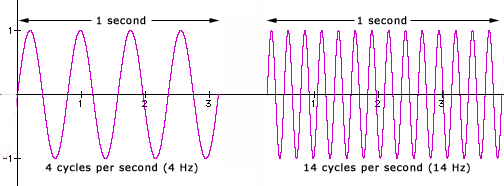
WHAT IS THE FREQUENCY OF DC VOLTAGE.

What is the frequency of DC voltage?
   > Due to the graphically straight line, DC voltage has 'NO' frequency but if this voltage is pure DC.
      Unpure frequency has 1.2Hz frequency.

What we do to do DC voltage pure?
   >We use Capacitor for filter the dc voltages for pure dc voltage with 'NO' frequency.

Your answer will be below. Comment below what you think about this.

dcfrequency

ELECTRICAL SWITCHBOARDS STANDARD TESTING PROCEDURE

Electrical Switchgear or Switchboard standard testing procedures step by step guide. These standard testing procedures are applying at Siemens Pakistan Co. as our knowledge (not confirm) also these are according to International Electromechanical Commission IEC and ISO standard too.

SiemensSwitchgear

All are not in details here but just names were given, for hints just. After this, you have to research it on the Internet for more details and for your knowledge on YouTube or Google. You will find more details easily when you search it by names.
Find the testing procedure names from above header pages of How Electrical blog where new beginners learn easily. Or you can direct go to Electrical switchboard testing page where you will get all these testing procedures easily by Click here and Watch this video #Siemens Switchgear.


Friday, 13 January 2017

QUESTION NEED YOUR ANSWER.

The question is about low voltage and frequency [Electrical Engineering].

Question: What are the disadvantages of low frequency?

Answer below comment box, so many peoples will learn from your comment.


electrical-questions

Thursday, 12 January 2017

SCADA SYSTEM - BASIC TO ADVANCED SCADA SYSTEM

SCADASystem is very famous now a days in Automation engineering and Electrical Industrial System. Usually power plant it is all the things now going into automatically systems so they use scada system to do So what is Scada how it can be used and more in details all from basic to advanced in this booklet. You can download it from here.

SCADA system
SCADA system - How Electrical blogspot

HOW TO MAKE MY OWN QUADCOPTER

So you want to make your own quadcopter huh? okay here I will share some important things with you by this you can try to make your own quadcopter easily if you have some knowledge about science and physics. I think if you have passed intermediate with foreign affiliated certificates in physics and science so you can make and learn it easy from this guide that share here.
\\

How to make quadcopter


\\
Download Wiring diagram file here and download Quadcopter science and tricks here.

Watch this video for better understanding how to make quadcopter. Subscribe me on YouTube.